

Japanese Tattoo Ideas & Designs
Browse Japanese tattoo ideas with matching on-body previews, understand the motifs and their meanings, and create your own design.
What Makes a Tattoo Japanese?
Japanese tattoo styles connect to art traditions, stories, and natural imagery from Japan. A design might feature a central subject—fish, flowers, guardian figures, or mythical creatures—rendered with clear contours, deliberate shading, and sometimes environmental elements like water, wind, or clouds that frame the main motif. Some compositions combine subject and background into a unified scene, while others present the subject alone. Both approaches use line, light, and dark to create depth and structure, whether in color or black and grey.
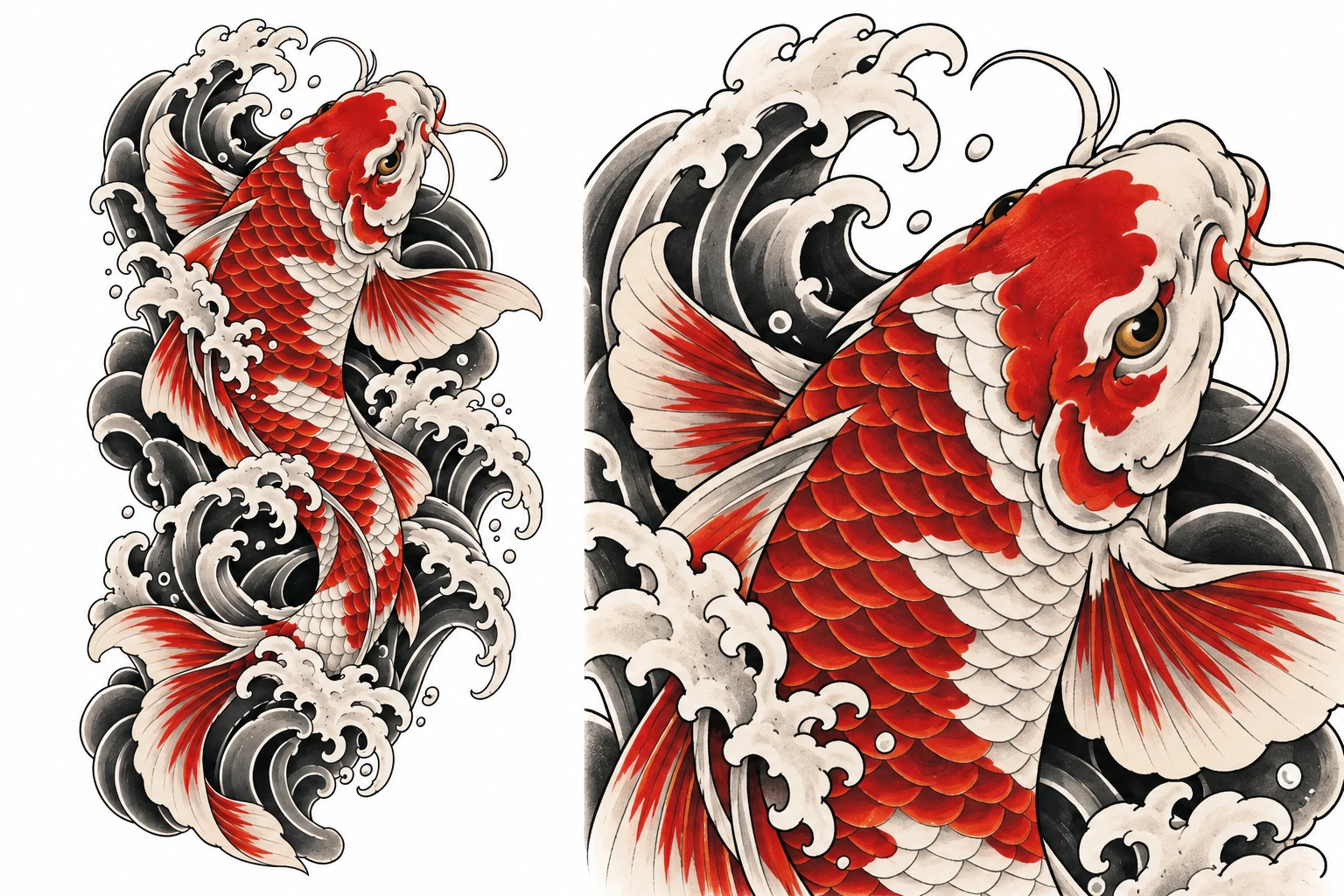
The red-and-white koi in this gallery moves between a lotus and curling waves. Black water connects the flower, fish, and lower edge into one half-sleeve. The indigo dragon takes a wider route across the chest and shoulder, with cloud shapes and a peony linking those areas. Both use a central subject and setting, but the first follows the arm downward while the second spreads across two body regions.
Notice how the dark background creates a continuous field around each subject and how the lighter skin breaks keep the main forms readable. Compare the direction and coverage of the actual designs before deciding which kind of composition you want to explore.
Traditional Japanese Tattoos and Irezumi
Irezumi is one term for Japanese tattooing. Early nineteenth-century Edo period woodblock prints by artists like Utagawa Kuniyoshi circulated widely and influenced tattoo imagery, establishing a visual vocabulary that connected to folklore, nature, and historical narratives. That imagery shaped both large-scale traditional work—sometimes planned as cohesive compositions across the body—and contemporary standalone pieces that borrow motifs and composition principles without the same scope. The aesthetic tradition continues to inform new work while also branching into different approaches.
Japanese Tattoo Motifs and Meanings
Japanese tattoo subjects carry associations that come from different sources. Some motifs link to auspicious ideas—wealth, good fortune—while others draw from specific characters, stories, or theatrical traditions. A peony, for instance, appears in tattoo work with associations of prosperity and good fortune, qualities that some artists and clients value as part of the flower's symbolic background. That interpretation reflects how the motif has been used in tattooing, not a universal code.
A Hannya mask offers a different kind of meaning. In Noh theater, the Hannya represents a jealous and vengeful female character transformed into a demon. The mask's horns, fangs, and fierce expression convey wrathful emotion, but its design also requires dignity and refinement—it is a deliberately crafted theatrical character with more depth than simply frightening imagery. This background shapes how the mask reads visually: the emotion is intense, but the form itself reflects controlled artistry.
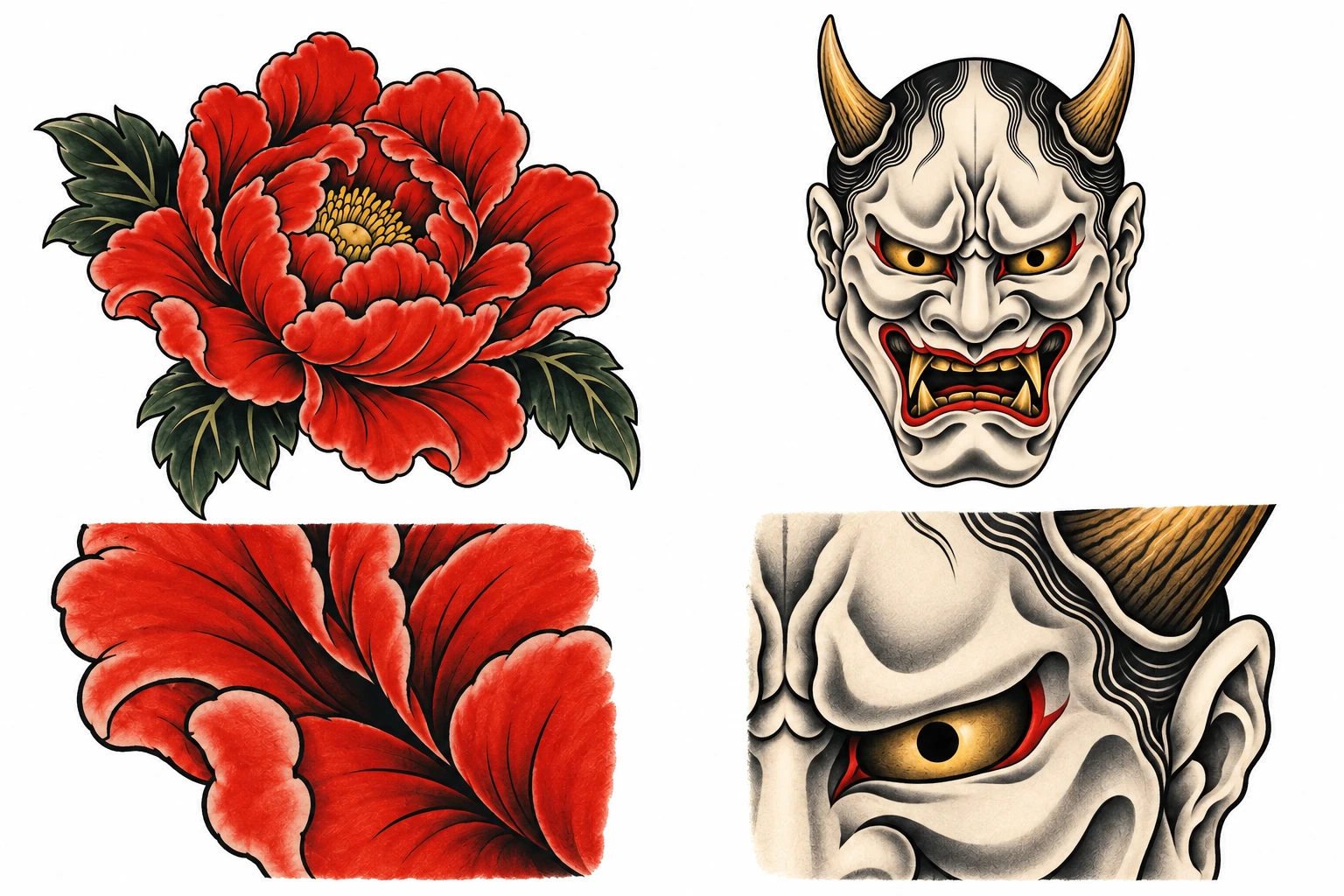
The gallery's angled ivory Hannya mask sits among chrysanthemums and wind, giving its fierce expression a setting and direction. The floral sleeve puts an open peony among chrysanthemums, leaves, and flowing wind without a face or animal as its focal point. Their different expressions come from the actual compositions as much as the subjects themselves. A cultural association does not prescribe a single visual tone; consider the full design you would wear.
Understanding the background can clarify whether a design resonates because of its story, its appearance, or both. You might find that knowing the Hannya's theatrical origins adds dimension to the image, or you might be drawn to the mask's visual impact without adopting its narrative.
Choosing a Japanese Tattoo for Your Placement
Shape and Placement
When comparing Japanese tattoo ideas, start by defining the area you want to cover. A design on the upper arm can occupy one face of the limb or wrap partway around; a shoulder piece can stay concentrated at the curve or extend down the arm. If you expect to add more work later, consider how this piece will relate to future sections. Traditional Japanese tattoo compositions often plan for connection across larger areas rather than treating each addition as a separate picture, so think about boundaries and potential extension before finalizing the design.
The koi, lotus, and waves form a connected half-sleeve from the rounded shoulder toward the elbow. The dragon, clouds, and peony extend across the chest before continuing over the shoulder and down the upper arm. Their matching on-body previews make the coverage and direction easier to compare than the flat designs alone.
Consider the angle from which you want to view the tattoo yourself and the angle from which others will typically see it. Check body previews that show shoulder and arm context rather than only cropped skin sections—they help you assess how the design sits and whether the coverage feels right for the area you have in mind.
Size and Detail
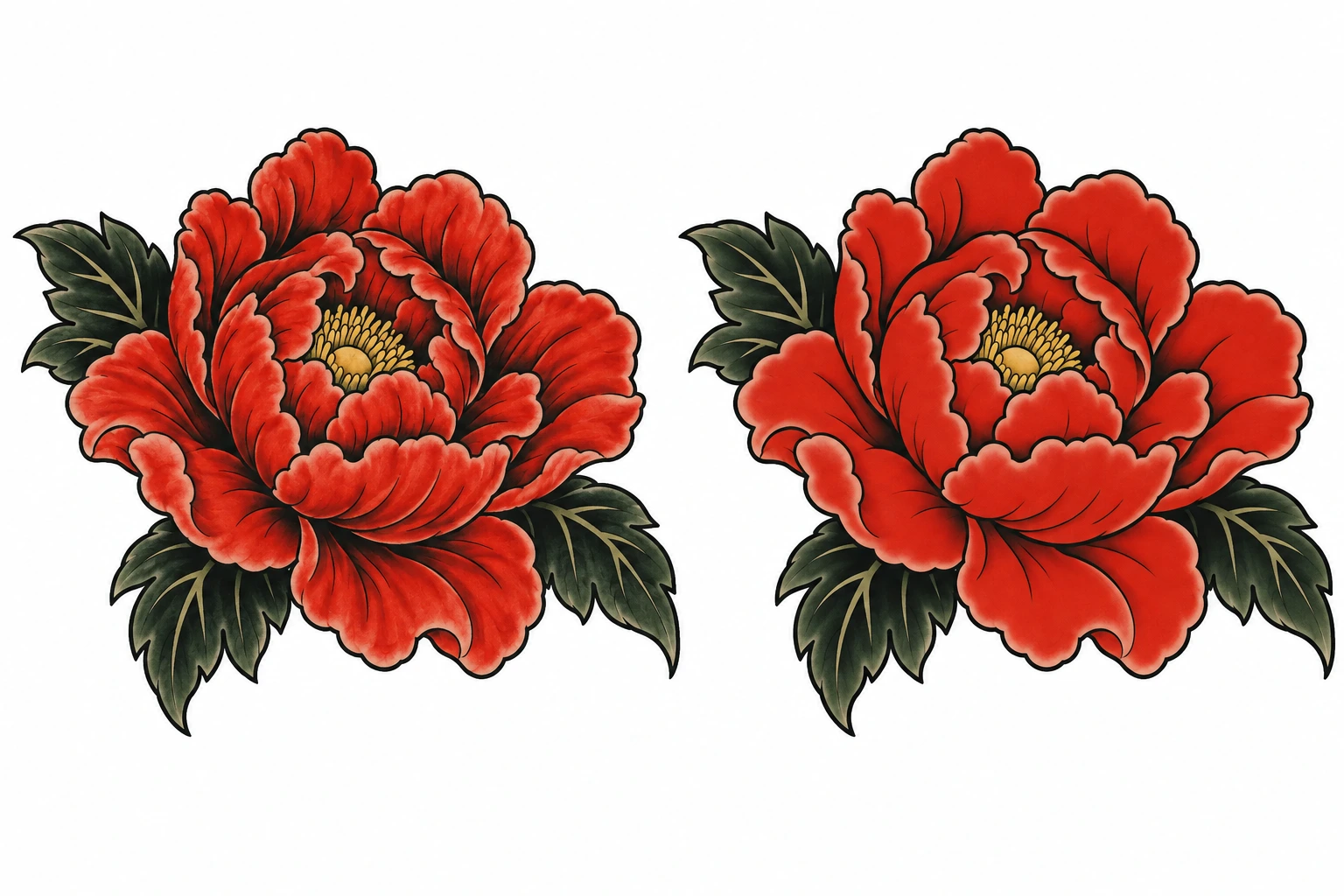
Once placement is clear, determine how much detail fits comfortably in that space. Look at the main identifying features of your chosen design—the koi's body curve and primary wave shapes, the peony's petal outlines and leaf forms—and distinguish them from secondary elements like individual scale textures or inner petal folds.
Not every mark needs equal emphasis. If you are drawn to a design's complexity, you might accept a larger area to preserve its density rather than uniformly shrinking a dense design. If your preferred size is fixed, consider a simpler version that reduces secondary textures while keeping the core subject clear.
When you are ready, discuss physical sizing and any necessary line adjustments with a tattoo artist for your actual body location.
Create Your Own Japanese Tattoo
Create your own Japanese tattoo designs inspired by a motif you like.
Japanese Tattoo FAQs
You can change the description and generate a new version with different colors, elements, or composition. This creates a new image rather than directly editing a selected region of the current one, so other details may also change.
Yes. Use it as a discussion reference for the subject, composition, and details you want. The artist will adapt it to your actual body location and tattooing requirements. It is not a finished stencil ready to apply as-is. Learn how to prepare a brief for your tattoo artist.
Open a design and choose “Create a similar design” to load its description and the Japanese style in the generator. You can review or change the description before generating.
Yes. Open a design and choose “Download this design.” Sign in to download a sample with the TatSketch watermark.